New brain imaging research reveals that left-sided and right-sided migraines are somewhat different conditions. That distinction couldunlock better, more personalized treatments. Here’s what it means for the carewe provide at our headache clinic.
If you’re one of the millions of people who suffer from migraines, you may have noticed that your headaches tend to strike on the sameside, time after time (mine, without exception, have always been on the left).In others, they can occur on either side or on both sides at once. About halfof all migraine sufferers experience their attacks predominantly on one side ofthe head, and roughly one in four always gets headaches on the same side. Itturns out that whether your migraine hits on the left or right side of yourhead may say something deep about what’s actually happening inside your brain,all the way down to the molecular level.
A new study published in The Journal of Headache and Painhas taken a significant step toward understanding why left-sided andright-sided migraines feel and behave so differently, using advanced brain imaging and genetic analysis to map out the distinct biological fingerprints ofeach type. For those of us working at the intersection of neuroimaging andneuromodulation, using brain scans to guide treatments like repetitivetranscranial magnetic stimulation (rTMS), this research speaks directly to whatwe do every day in the clinic.
What scientists have long suspected but struggled to explain is that left-sided migraines and right-sided migraines aren’t just thesame condition happening in different locations. Clinically, they seem to begenuinely distinct experiences. Left-sided migraines tend to be more closelyassociated with anxiety, emotional distress, and reduced quality of life, whileright-sided migraines appear more tied to the raw intensity of physical painand cognitive difficulties. Many of our patients describe exactly this. Someare overwhelmed by the emotional toll of their migraines: the dread, the impacton relationships, and daily function. Others describe the pain itself as themost disabling feature. This research begins to give us a biologicalexplanation for that difference.
Peering Inside the Brain
To investigate, researchers from researchers in China scanned the brains of 77 migraine patients (35 with left-sided migraines and 42with right-sided migraines) and 77 healthy volunteers using functional MRI(fMRI), a brain imaging technique that detects neural activity by measuring changes in blood flow across brain regions.
Their focus was on interhemispheric connectivity: how well the brain's left and right hemispheres communicate. In a healthy brain, corresponding regions on each side are tightly synchronized. Theresearchers measured this synchrony using a technique called voxel-mirroredhomotopic connectivity (VMHC), examining both the average level of communicationover time (static connectivity) and how that communication fluctuates moment tomoment (dynamic connectivity).
This dual approach is important. Static connectivity gives you a snapshot average, while dynamic connectivity captures whether thebrain’s communication is stable or erratic over time. Both matter when tryingto understand a disorder like migraine, which is itself episodic andfluctuating by nature.
The Brain’s Two Sides Tell Different Stories
Both groups of migraine patients showed disrupted communication between brain hemispheres, but in different networks.
Left-sided migraine patients had reduced connectivity in a cluster of brain regions called the default mode network,sensorimotor network, and visual network. These are regions involved inself-reflection, body awareness, and visual processing. Critically, thedisruption in their visual and salience networks directly correlated withemotional pain scores and quality of life measures. In other words, the brainchanges in left-sided migraine may help explain why these patients are morelikely to struggle with anxiety and emotional suffering alongside theirheadaches, and sometimes in between them too.
Right-sided migraine patients, on the otherh and, showed disrupted connectivity in the brain’s cerebellar and limbicnetworks, regions involved in movement coordination and deeper emotionalprocessing. Their connectivity disruptions correlated strongly with the sensationof pain rather than its emotional coloring. This aligns with what manyright-sided migraine patients tell us: the headache is physically ferocious butmay not carry the same emotional weight or anxiety burden.
So the side of your migraine may actually determinewhether the brain changes affect how you feel pain emotionally versus how intensely you experience it physically. These aren’t just philosophicaldistinctions. They point to different brain circuits and potentially differenttherapeutic targets.
Going Deeper: Neurotransmitters and Genes
The researchers cross-referenced their imaging data with detailed maps of neurotransmitter systems, the chemical messengers that neuronsuse to communicate, and with a comprehensive database of gene expression acrossthe human brain called the Allen Human Brain Atlas. This allowed them to asknot just where the brain changes are occurring, but also what chemistry underliesthem and which genes are driving them.
The results revealed another striking layer of difference.
Left-sided migraine was linked to disruptions in dopamine (a neurotransmitter tied to reward, motivation, and movement regulation) and noradrenaline (related to the stress response, attention, and arousal). At the genetic level, the abnormalitiesmapped onto genes related to energy metabolism and oxidative stress, specifically how brain cells produce energy in their mitochondria and how theyrepair cellular damage. This is particularly intriguing because mitochondrialenergy deficits have long been suspected to play a role in migraine, and theleft-sided variant may be where this mechanism is most pronounced.
Right-sided migraine was linked to disruptions in dopamine and GABA, the brain’s primary inhibitory or calming neurotransmitter. When GABA signaling is impaired, the brain canbecome overly excitable and hypersensitive to pain signals. Genetically, theright-sided abnormalities clustered around synaptic plasticity and signal transmission, the processes by which brain connections are strengthened or weakened and how signals travel between neurons. This fits with the clinicalpicture of right-sided migraine as a condition dominated by intense, raw paindriven by an overexcited nervous system.
What This Means for How We Treat Migraines at Our Clinic
This is where the research connects directly to the work we do and the care you receive here.
Repetitive TMS for Migraine
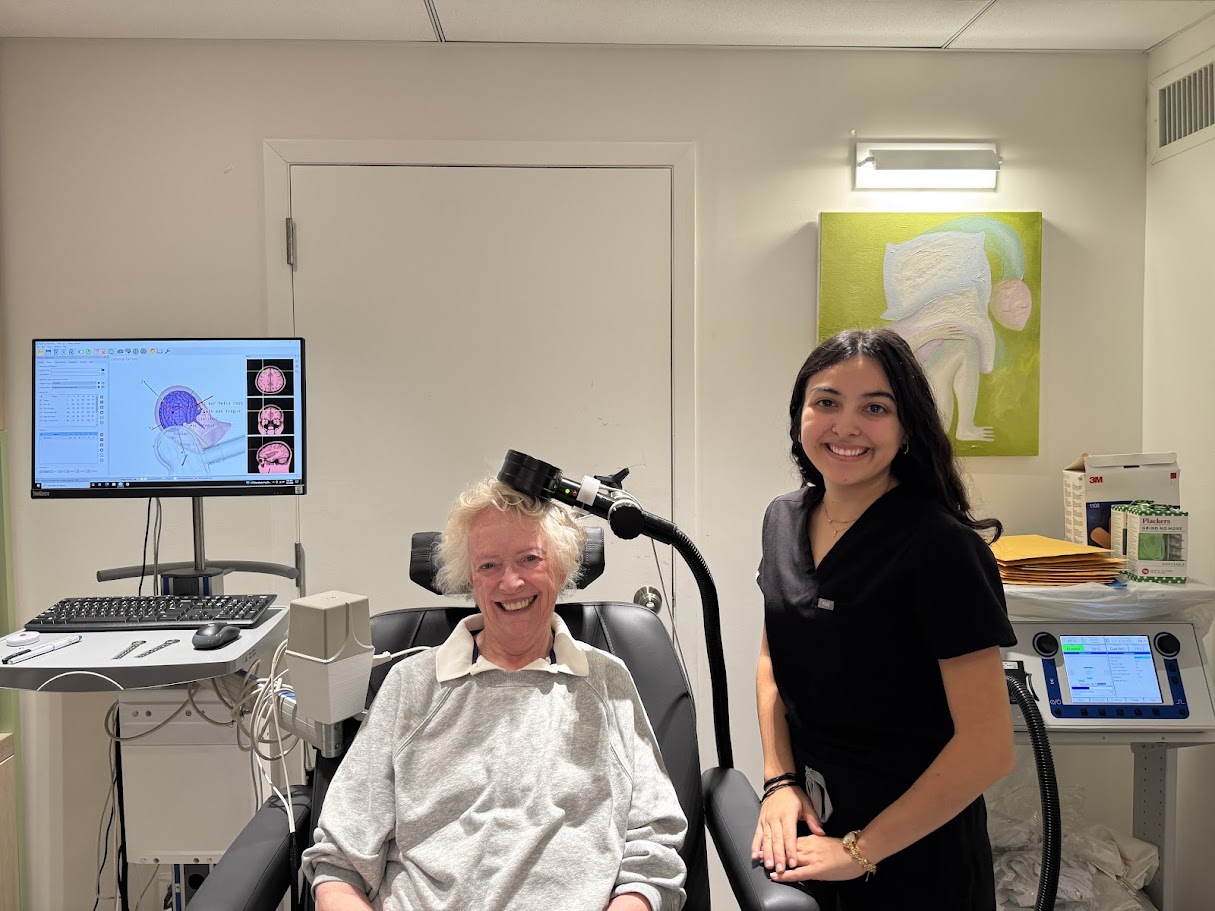
Repetitive transcranial magnetic stimulation (rTMS) is a noninvasive brain stimulation treatment that uses magnetic pulses to modulateneural activity in targeted brain regions. Unlike medications, which actthroughout the body, rTMS can be directed at specific cortical areas, making itone of the most precise tools we have for treating neurological conditions likemigraine.
During rTMS, a coil placed near the scalp delivers rapid sequences of magnetic pulses. Depending on the frequency and pattern used,these pulses can either increase or decrease the excitability of the neuronsbeneath the coil. For migraine, the goal is typically to calm overactiveregions or restore normal connectivity patterns, essentially helping the brainreturn to a healthier equilibrium.
The research discussed above directly informs this work. If left-sided and right-sided migraines involve disrupted connectivity indifferent brain networks and are driven by different neurotransmitters andgenetic mechanisms, then it follows that they may respond best to rTMS appliedto different brain regions. Stimulating a region involved in visual andemotional processing might be most relevant for a left-sided migraine patient,while targeting circuits involved in pain signal amplification might be moreappropriate for someone with right-sided migraine. This is the promise ofprecision neuromodulation, and it is the direction our field is actively movingtoward.
How We Use fMRI to Guide rTMS
One of the things that distinguishes our approach at this clinic is that we don’t simply apply rTMS to a standard location based onanatomy alone. We use functional MRI to identify each patient’s brain connectivity patterns before treatment begins, then use that information to guide where we direct magnetic stimulation.
Here’s how that works in practice. When you undergo an fMRI scan, we’re not just looking at the structure of your brain. We’re mappinghow different regions communicate with each other at rest. This resting-statefMRI provides a functional wiring diagram unique to you. We identify whichnetworks are disrupted, which regions are hyperactive or underactive, and wherethe synchrony between hemispheres has broken down.
This is exactly the kind of information the new research quantifies: interhemispheric connectivity, network-level disruptions, and thespecific regions where left-right communication has gone awry in migraine. Byoverlaying your personal fMRI connectivity map with findings from research likethis on migraine subtypes, we can pinpoint the brain regions most likely tobenefit from rTMS and tailor the stimulation parameters accordingly.
Think of it this way. rTMS without fMRI guidance is like trying to tune an instrument by ear in a noisy room. fMRI-guided rTMS lets ussee exactly which string is out of tune and how much it needs to be adjusted.
How We Use it in Practice
Because of cost (fMRI is usually not covered by insurance), not all patients choose to undergo an fMRI. The new study will helpus with treatment planning when fMRI data are unavailable. When a patient comesto us with predominantly left-sided migraines and reports significant anxiety,emotional distress, and reduced quality of life between headaches (not justduring them), this research suggests their brain connectivity disruptions maybe concentrated in emotional and visual processing networks, with dopamine andnoradrenaline systems particularly implicated.
By contrast, a patient whose right-sided migraines are characterized by extreme pain intensity, allodynia (when even light touch feelspainful), and sensory hypersensitivity may have disruptions in cerebellar andlimbic networks and a GABA-related deficit in inhibitory control.
A Note on What This Research Is and Isn’t
The limitations of this study are that it involved only77 migraine patients at a single center in China and was cross-sectional,meaning it captures a snapshot in time rather than tracking patients overmonths or years. The molecular findings, while fascinating, are based on statistical correlations between brain imaging and gene databases, not directmeasurements of what’s happening in any individual patient’s neurons.
So we can’t walk into the clinic and use this paper as a treatment recipe just yet. What it does provide is a compelling, biologicallygrounded framework for understanding why left and right migraines aredifferent, and it strengthens the scientific rationale for the individualized,fMRI-guided approach we already practice.
This research needs to be duplicated and expanded before it can be accepted as fact.
What This Means for You as a Patient
Pay attention to your headache side. When you track your migraines, note which side is affected. Consistentlateralization is clinically meaningful, and the more information you can sharewith us, the better we can tailor your care.
Your fMRI scan is more than a picture. Thebrain imaging we perform before rTMS captures the specific connectivity disruptions in your brain, which may reflect the migrainebiology described in this study. It is one of the most important tools we havefor ensuring your treatment is targeted where it can do the most good.
Your emotional experience of migraine is a brain phenomenon, not a weakness. If you have left-sided migraines and struggle significantly with anxiety, fear of the next attack, or a sense thatmigraines have eroded your quality of life, this research suggests thoseexperiences have a neurobiological basis. The same brain network disruptionsthat alter left-right connectivity also appear to modulate emotional painprocessing. Addressing that through targeted neuromodulation is a legitimateand important therapeutic goal.
Precision migraine treatment is coming, and we’re already practicing it. The vision described in this paper, matching treatment to the specific biology of an individual’s migraine, is what we hopeto see in the near future. It applies not only to imaging but also to genetics.Genetic analysis combined with imaging data may allow us to offer precisiontreatment, rather than the trial-and-error approach we rely on now.
This blog post is based on a study published in The Journal of Headache and Pain (2026) by OuYang X. et al. As with all early-stageresearch, findings should be interpreted with caution. This post is intendedfor educational purposes and does not constitute individualized medical advice.Please speak with your treating clinician about your specific situation andtreatment options.