


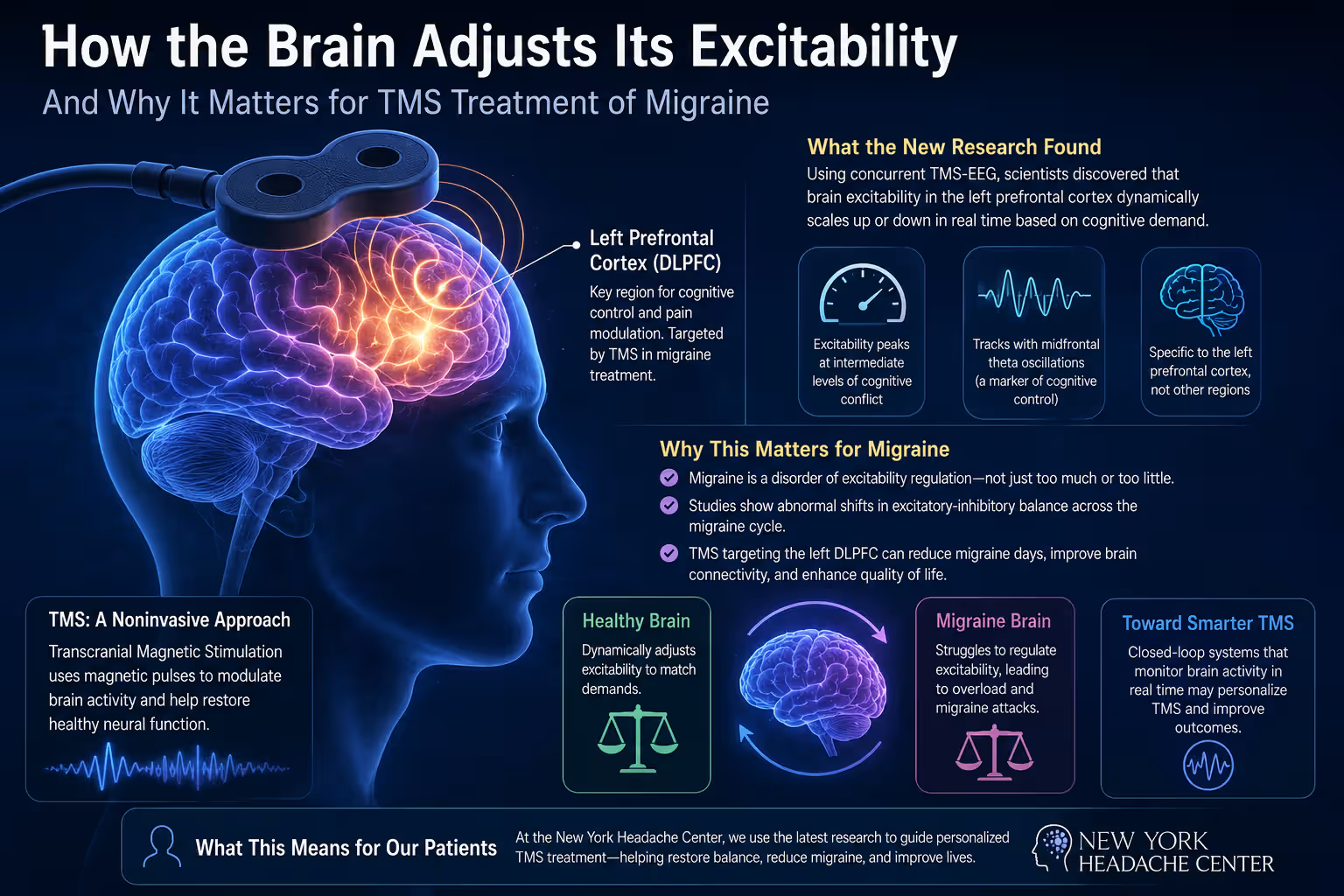
At the New York Headache Center, we use transcranial magnetic stimulation (TMS) as one of the tools in treating chronic migraine and other neurological conditions. New research from Stanford, led by Umair Hassan, Corey Keller, and colleagues, sheds light on how TMS interacts with the brain—and why this matters for patients with migraine.
What the Study Found
Using concurrent TMS-EEG, researchers delivered single magnetic pulses to the left prefrontal cortex of 27 healthy participants while they performed a challenging cognitive task (the Multi-Source Interference Task, or MSIT).
This task forces the brain to manage conflicting information—similar to the sensory overload many migraine patients describe as a trigger.
The key finding:
The brain’s prefrontal excitability dynamically adjusts in real time based on cognitive demand.
- Excitability increased as task difficulty increased
- It peaked at intermediate levels of conflict (maximum uncertainty)
- These effects were measurable at the individual level—not just group averages
The study also found:
- Prefrontal excitability closely tracked midfrontal theta oscillations, a known marker of cognitive control
- The effect was specific to the left prefrontal cortex, not other brain regions
Why This Matters for Migraine
Migraine is increasingly understood as a disorder of cortical excitability regulation.
It’s not simply that the brain has “too much” or “too little” activity. The problem is that it fails to appropriately adjust excitability in response to changing demands.
Research has shown:
- Cortical responsiveness fluctuates across the migraine cycle
- Excitatory–inhibitory balance becomes unstable
- These shifts may trigger attacks
The Hassan study captures this kind of real-time excitability tuning in healthy brains.
If a healthy brain can fine-tune excitability to match cognitive demand, then a brain that cannot regulate this process may be vulnerable to:
- Sensory overload
- Cognitive fog
- Migraine attacks
TMS-EEG studies in migraine patients already show:
- Reduced TMS-evoked potentials (e.g., N100) → impaired inhibitory (GABAergic) control
- Cyclical changes in excitability:
- Increased before attacks
- Suppressed during and after
This suggests a system that struggles to maintain equilibrium.
The Left Prefrontal Cortex: A Critical Target
The study highlights the left prefrontal cortex as uniquely responsive to cognitive demand.
This is also the primary target for TMS treatment of chronic migraine.
Clinical findings show:
- High-frequency rTMS to the left dorsolateral prefrontal cortex (DLPFC) can reduce migraine frequency by ~8 days/month vs. sham
- Increased frontal–temporal connectivity correlates with reduced pain and migraine days
- Theta burst stimulation improves:
- Headache frequency
- Medication use
- Cognitive performance
This overlap is not coincidental.
The same region that dynamically regulates excitability in healthy individuals is where TMS produces consistent clinical benefit.
The prefrontal cortex also plays a central role in:
- Pain perception
- Emotional modulation of pain
Some patients report migraine improvement after TMS for depression.
At our center:
- We often stimulate additional brain regions for neurological symptoms
- We use fMRI-guided targeting for greater precision
Toward Smarter, More Personalized TMS
A key implication of this research is state-dependent neuromodulation.
TMS effects depend on what the brain is doing at the moment of stimulation.
Current protocols:
- Deliver stimulation at fixed intervals
- Do not account for real-time brain state
In practice, we already adapt:
- Patients rest during treatment (no phones, reading, etc.)
- Less intensive schedules (1–3 sessions/week) often work well for neurological conditions
- Compared to standard depression protocols (30–36 sessions over 6–7 weeks)
Emerging direction:
- Closed-loop TMS systems
- Real-time EEG monitoring
- Stimulation timed to optimal brain states
This could allow true personalization of treatment, improving outcomes in migraine and beyond.
What This Means for Our Patients
At the New York Headache Center, this research reinforces key principles guiding our approach:
- Migraine involves dysregulation of excitability, not just excess or deficiency
- The left prefrontal cortex is central to both cognition and pain modulation
- TMS may work by restoring the brain’s ability to regulate its own activity
- The future of TMS is personalized and state-dependent
If you suffer from chronic migraine and have not responded to medications, TMS may be an effective and well-tolerated option.
Contact the New York Headache Center to learn more.
Note
The Hassan et al. study is currently a preprint and has not yet undergone peer review. However, its findings are consistent with a large body of published research on cortical excitability, TMS, and migraine.
If you want, I can also convert this into Webflow CMS fields (summary, SEO description, slug, etc.) or tighten it for a more marketing-focused page.




