Migraine aura is a visual disturbance that usually precedes the headache in about 20% of migraine sufferers.
The aura can sometimes occur without a headache and some people, myself included, always have migraines and auras independently of each other. A typical aura usually lasts 20-30 minutes and consists of partial loss of vision on one side of both eyes, or flashing lights, colored zigzags, or tunnel vision.
Most headache specialists and neurologists have always believed that most people have an aura first and when it resolves, the headache begins. A study by Dr. Jakob Hansen suggests that this may not be the case. He examined diaries of 201 adults who experienced 861 migraine attacks and discovered that in 61% of attacks the headache was present within 15 minutes of the onset of aura. Nausea was present in 40%, sensitivity to light (photophobia) in 84% and to noise (phonophobia) in 67% within 15 minutes of the onset of visual aura. I have heard from some of my patients similar reports of a headache and aura starting at the same time, but it seemed that those were a small minority. I will have to be more thorough in questioning my patients. One practical application of this finding is that we usually tell patients who use injectable sumatriptan (Imitrex) to treat their migraine attacks to wait for the aura to resolve and then take the injection. The reason for this delay is a perception that the injection will not help if taken during the aura phase. It is speculated that if the medicine gets into the brain circulation before pain starts it may not be able to attach itself to certain receptors. We do recommend taking a tablet as soon as the aura starts because it takes at least 30 minutes for a tablet to be absorbed. If Dr. Hansen’s results are confirmed, then most people should not wait to give themselves an injection of sumatriptan.
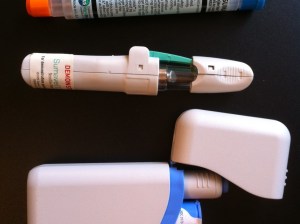
Since we are on the subject of injections, I should point out that they are extremely underutilized. Doctors usually prescribe them if the patient has severe nausea or vomiting and cannot hold down the pill. However, an injection may also be very useful for someone who wakes up with a headache without severe nausea, but they know that the tablet may take 2 hours or longer to provide relief. Taking an injection, which can stop the headache within 10 – 15 minutes, can make a difference between being able to go to work or not. I sometimes take an injection even when I have a mild migraine if it happens at night. The tablet will usually work, but I may have to wait for two hours before I can fall asleep, so I take a shot. From left to right 3 types of sumatriptan injectors: Alsuma, Sumavel, Imitrex injections.