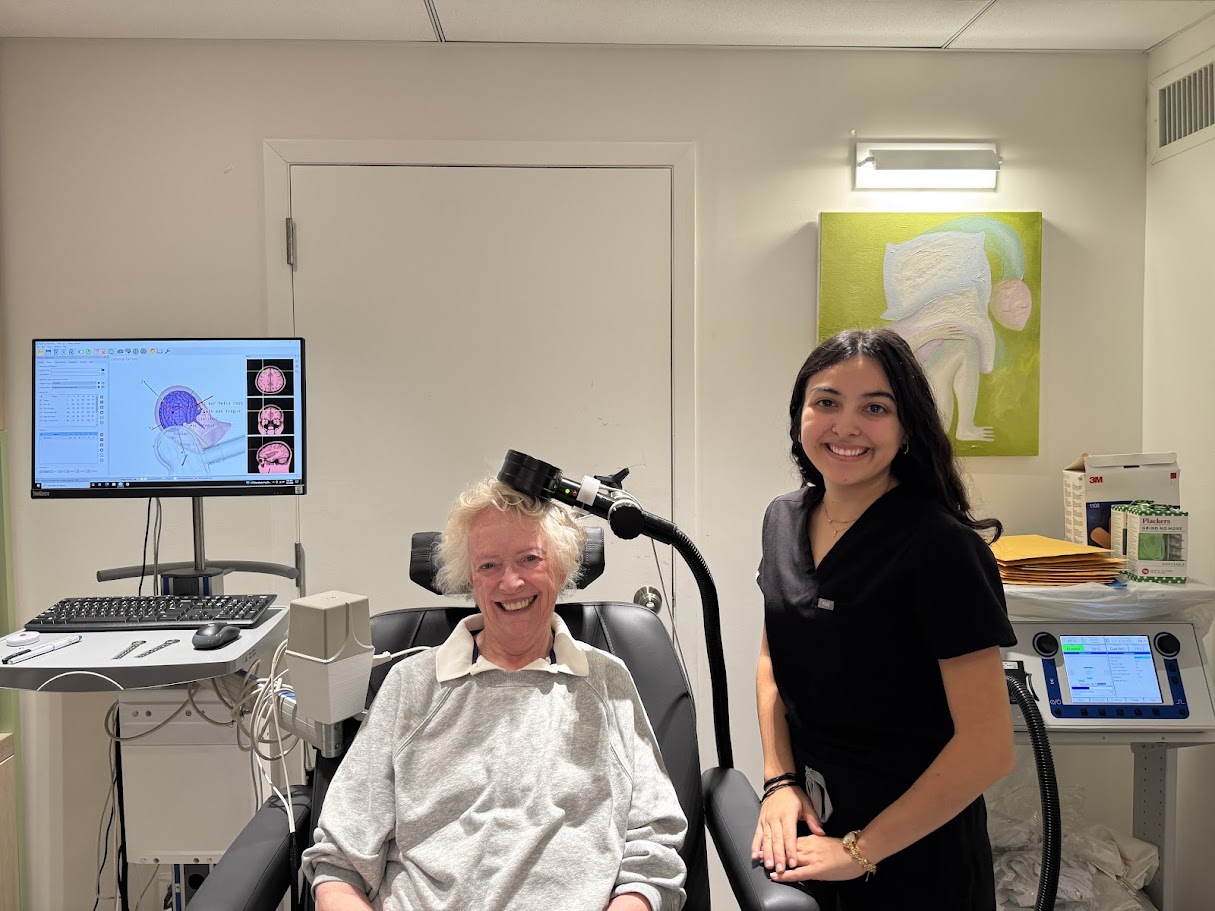


Transcranial magneticstimulation (TMS) has come a long way since my residency years in the 1980s,when it was an experimental tool. Today, it is FDA-cleared for depression,anxiety, and OCD, and the evidence base now extends to migraine, chronic pain,postconcussion syndrome, and cognitive dysfunction. The most interesting shiftin the field is not about how much or how we stimulate, but where. A new waveof research shows we can make TMS meaningfully better by using brain imaging topersonalize the target.
At the NY Headache Center, wehave been using fMRI-guided rTMS to treat chronic migraine, posttraumaticheadache, and other pain syndromes, so these developments support our approach.
Two recent studies make thecase. At this year’s Clinical TMS Society meeting, Dr. Danielle DeSouzapresented real-world outcomes from Acacia Clinics. In 195 patients treated withaccelerated TMS for depression, the overall response rate was about 73%. Whenshe compared fMRI-guided targeting with standard scalp-based targeting usingpropensity matching, the fMRI-guided group responded at 77.5% versus 62.2%. Ofall the variables examined, fMRI guidance was the only significant predictor ofresponse. Not baseline severity, not prior treatment failures, not age, notsex.
A recently published randomizedtrial in JAMA Psychiatry by Dr. Joseph Taylor and colleagues points thesame way. In 40 adults with treatment-resistant depression, connectivity-basedtargeting produced significantly greater depression score (MADRS) reductionsthan scalp-based targeting (median 24 vs. 18 points). The trial also showedthat individualized fMRI targets were reproducible within a person butmeaningfully different between people, which is exactly why a one-size-fits-allapproach is not ideal.
The target that works fordepression is not the target that works for migraine. For depression, theproductive site in the dorsolateral prefrontal cortex (DLPFC) is anticorrelatedwith the subgenual anterior cingulate cortex (sgACC), a region tied to emotionalprocessing and sadness. For migraine, the relevant DLPFC site connects to thepregenual ACC (pgACC), which is engaged during noxious stimulation andpain-related processing. A 2026 open-label trial by Zhen et al. personalizedrTMS to the migraine-relevant pathway in 21 patients and found a 52% responderrate maintained at follow-up, with connectivity changes distinguishingresponders from non-responders at 73% sensitivity and 80% specificity.
Large neuroimaging workreinforces the idea that migraine is fundamentally a network disorder. TheREFORM study (264 patients, 151 controls) identified increased connectivitybetween the middle cingulate cortex and the occipital pole as a consistent signatureacross all migraine subtypes. When the disorder lives in a distributed network,stimulating one generic spot is unlikely to help every patient.
When we obtain fMRI data on apatient, it often points to targets beyond the standard DLPFC location, andsometimes beyond the DLPFC entirely. That is the real value of imagingguidance: it lets us identify targets specific to both the condition and the individual,which matters most in patients with complex, overlapping problems, likecomorbid migraine and depression.
In the absence of fMRI data, ourstandard approach is multisite stimulation of the left DLPFC, along with eitherbilateral motor cortex or bilateral occipital cortex. That differs from mostpublished protocols, which target a single site, but it follows from the samelogic: pain processing (motor cortex), mood and cognition (DLPFC), and corticalhyperexcitability (occipital cortex) are distinct dimensions of the disorder,and a distributed problem may call for a distributed solution. No trial has yetdirectly compared multi-site against single-site stimulation for headache, sothis remains an informed clinical choice rather than a settled question.
As Dr. DeSouza puts it, we havespent years optimizing dose, session spacing, and pulse number, and thoseparameters matter. But the target deserves to be treated as a core part of theintervention, not a technical afterthought. The question is no longer simplywhether TMS works, but which circuit we should target, for which patient, withwhich condition.
Accelerated rTMS is makingtreatment faster. Functional imaging is making it more precise. And theapplications reach well beyond depression. The main obstacle to wide adoption,at this point, is cost.